After Trump’s clean-energy clawback, tribes ‘turn and face the storm
The administration ripped away hundreds of millions of dollars for clean energy projects on tribal lands. Now tribes are fighting to salvage their work.
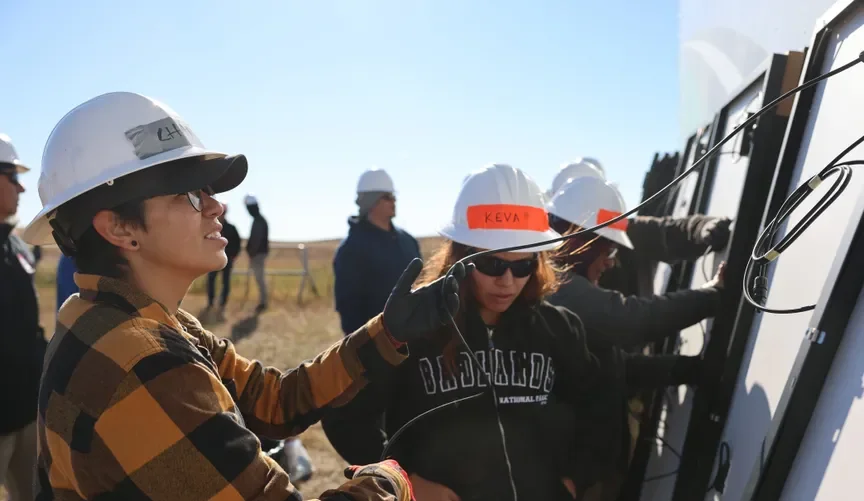
Indigenized Energy workers install solar panels on the Pine Ridge Reservation of the Oglala Sioux Tribe as part of a Solar for All kickoff project. (Freedom Forever)
Canary Media | Jan 29, 2026
By Jeff St. John
Donica Brady has worked as a security guard, a school bus driver, and a fabricator of corrugated metal and bridge girders. But her favorite job has been helping to bring solar panels and batteries to tribal communities struggling to pay their utility bills.
“I grew up in a single-parent home,” said Brady, an enrolled member of the Northern Cheyenne Tribe. “My mom sometimes had to choose which bills to pay. One of the highest bills here is electricity.”
So when Brady got a job offer from the nonprofit group Indigenized Energy, she leapt at the chance. She started by doing community outreach for a $4 million federal grant–funded effort to bring solar to tribal homes and schools. But a much bigger opportunity opened up in 2024, when the Indigenized Energy team joined a five-state, 14-tribe coalition awarded $135.6 million from the Solar for All program, created by the Inflation Reduction Act.
The partners got to work quickly and were able to install two kickoff projects on tribal land in South Dakota and northern Montana. Some of those projects included batteries to provide resiliency against blackouts. One elderly woman in Montana equipped with a solar-battery system didn’t even realize the grid had gone out during a storm last winter, Brady said. “The battery kicked in, and the system was sized right to keep her house powered.”
But Brady lost her job this summer, after the Environmental Protection Agency clawed back the entirety of $7 billion in Solar for All funds — including Indigenized Energy’s grant. Legal challenges against this and other Trump administration rescissions of federal clean-energy funding are underway.
In the meantime, however, the six tribal-focused consortiums that received a total of $504 million in Solar for All funding, including the Tanana Chiefs Conference in Alaska, the Hopi Utilities Corp. in Arizona, and multi-tribal coalitions in the upper Midwest and Northern Plains, have had little choice but to delay projects that require ongoing federal reimbursement — and to lay off workers they can’t afford to pay, like Brady.
“There was money in there for weatherization, for roof replacements, for heat pumps, for a lot of different things to help people,” she said. “After being laid off, I still have people who reach out, and I try to help them as best I can, to point them in the direction of people who may have more answers.”