A machine learning-based evidence map of ocean-related options for climate change mitigation and adaptation
npj Ocean Sustainability
Published: 19 November 2025
By Devi Veytia, Gaël Mariani, Vicky Martí Barclay, Laura Airoldi, Joachim Claudet, Sarah Cooley, Alexandre Magnan, Simon Neill, U. Rashid Sumaila, Olivier Thébaud, Christian R. Voolstra, Phillip Williamson, Marie Bonnin, Joseph Langridge, Adrien Comte, Frédérique Viard, Yunne-Jai Shin, Laurent Bopp & Jean-Pierre Gattuso 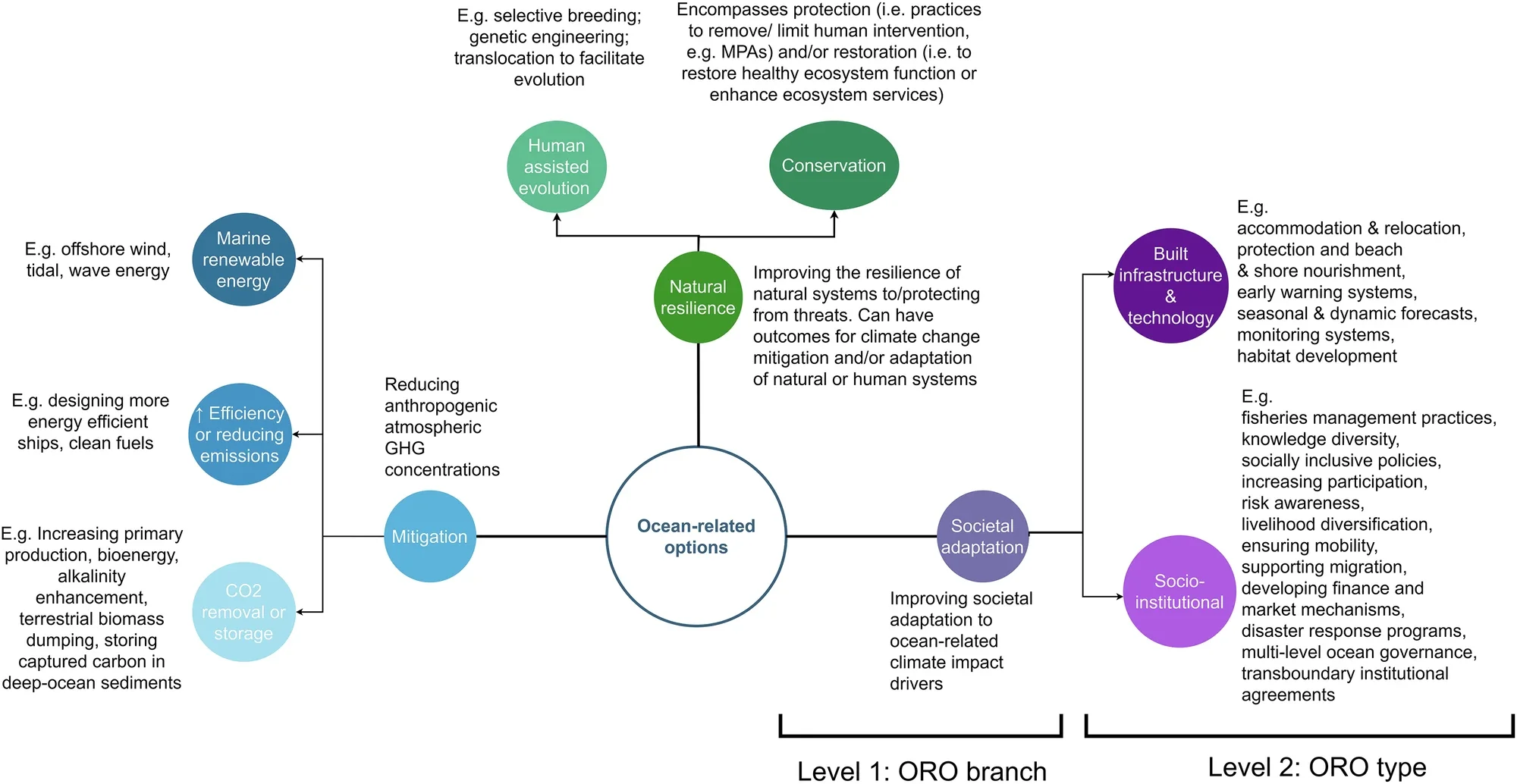
The typology is inspired by Gattuso et al.2 and specifies two hierarchical levels of ORO types (represented by the centre circle). The first level classifies all OROs into three main ‘branches’ based on their mechanisms of mitigating climate change or adapting to climatic impact-drivers (from left to right): to mitigate climate change by reducing atmospheric greenhouse gases; improving the resilience of natural systems to adapt (with potential mitigation co-benefits); and improving societal adaptation. These branches are further classified in a second level specifying ORO ‘type’. NB. to avoid double-counting interventions, each intervention is coded into only one ORO type. Since ‘natural resilience’ OROs often target multiple climate objectives (e.g., conservation of blue carbon habitats may target mitigation and adaptation), we allow for this in our typology.
Abstract
The ocean has a vital role to play in addressing the global challenge of climate change, which requires both mitigation and adaptation actions. The exponential increase in research relating to ocean-related options (OROs) requires a rapid and reproducible method to assess the state of knowledge. We train a state-of-the-art large language model to characterise the landscape of ORO research by classifying 44,193 (±11,615) articles across various descriptors. Research proves to be unevenly distributed, concentrating on OROs with mitigation objectives (80%), while revealing research gaps including under-researched ecosystems and an observed paucity of studies simultaneously assessing different ORO types. We also uncover social inequalities driven by mismatches between the global distribution of research effort, climate change responsibility, and risk. These findings are important to maximise the efficacy of OROs, position them within broader climate action portfolios, and inform future research priorities.