Angry Mountains and the Himalayan Tsunami: Why Indigenous Knowledge Matters
Indigenous worldviews cannot consist in granting rivers, mountains, and wetlands legal personhood since it only universalises a Western concept of rights and personhood and risks romanticising the ‘ecological native’ without the accompanying commitment to Indigenous peoples’ own right to decide what happens on their land.
The Commons | Lieselotte Viaene | 28 September 2026
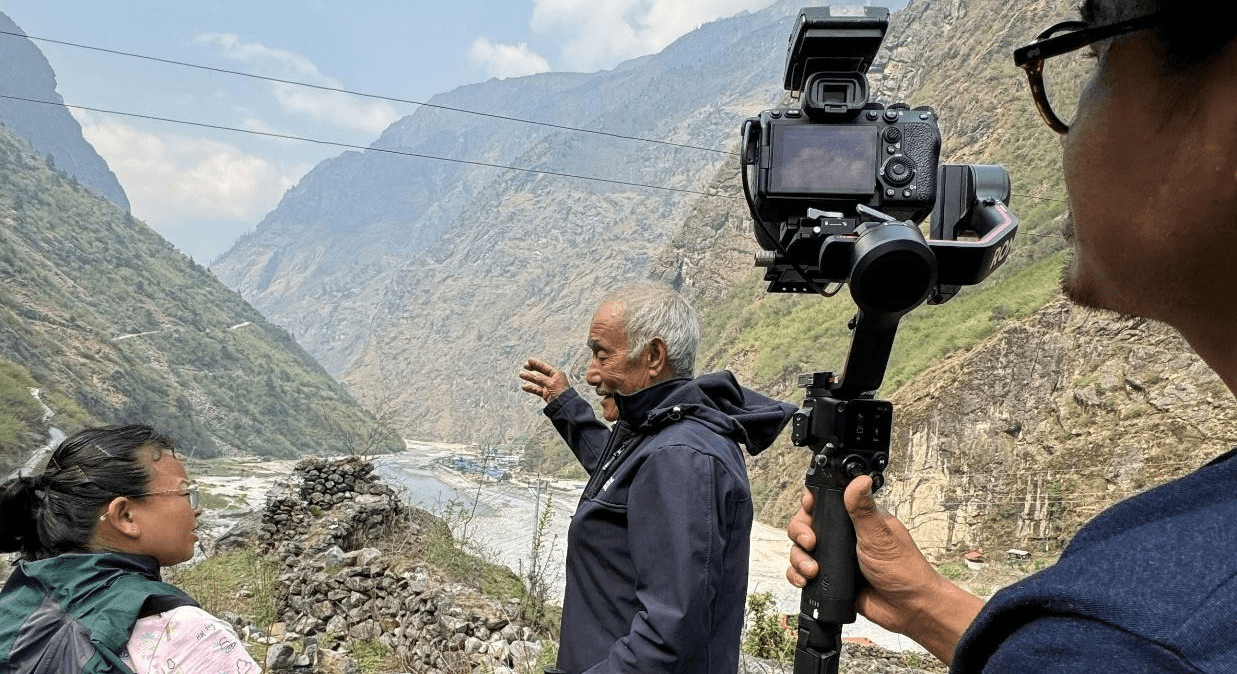
Gurung jhankri with Tal village in the background, Manang district.
September 2004. We were a few days into the Langtang–Helambu trail when we heard one evening that several people had died in a landslide in Dhunche, the national park’s entry point. Twelve days later, back on the road to Kathmandu, our bus was stopped and checked by the army more than once. Nepali passengers had to step out while the few foreigners on board had to show their passports. Back at the hotel in Kathmandu, we learned that a car bomb had exploded in the city the day before we arrived. Nepal was still at war. Kathmandu itself had little reliable electricity then, families and businesses organised their lives around random power outages. I did not expect that, 19 years later, after most of my professional life spent in Latin America, I would return to the Himalaya, not for another long trek, but to learn from its rivers, its Indigenous communities, and the complexities of hydropower and energy transitions.
In October 2023, when we sat with a Gurung jhankri (shaman) in the village of Tal by the Marsyangdi river, we asked him about the flood that had torn through the Manang region in 2021. He answered carefully. ‘I don’t know why it had happened,’ he told us. ‘It might be that the goddesses who reside in the mountains were angry.’
Some nights before the water came, he remembered, ‘I had dreamt of it.’
Then, almost as an aside, he told us about a different kind of damage, from years before. The army had been blasting a hillside across the Manang valley to build a road. ‘As you can see, they keep doing blasting and making holes in different places. When that was happening, people could feel the presence of deities, as if they had appeared. They could hear crying the whole night. The crying would be heard in different places, as if they were wandering from one hill to another. When their home was blasted and destroyed, they became homeless.’
I keep returning to that testimony because it holds, in one breath, the two things this essay is about. An Indigenous shaman who will not claim certainty about why a river turned violent, yet is entirely certain that a mountain can feel a blasting as violence, and answer it with grief. And a flood, five years old now, that still has almost no place in how the world explains Himalayan disasters.
In April 2024, on the second day of filming in the mountains above the Marsyangdi river for our short documentary Marsyangdi Wile Ri’iba: May You Live as Long as the River, an elder Gurung woman looked at the camera and said what everyone around her was already feeling. ‘In the beginning, we didn’t agree to give our lands. What if the Goddesses don’t want to be shifted? What if they want to stay in the original sacred site? If they don’t agree, we’ll be cursed with sickness and bad luck.’
She was talking about a power substation of the Marsyangdi Corridor 220 kV Transmission Line Project, which would transport around 1600 MW of power generated from different hydropower stations in this basin. She was not talking about a flood but about the female guardians of a sacred site the project required to be destroyed.
This is now the third time in five years I know of that this Himalayan river system has tried to tell us something: a dream and a blasted hillside in the Marsyangdi valley in 2021, a threatened sacred site in that same valley in 2023, and, on the 26th of August this year, in the neighbouring Trishuli basin, in a catastrophe that made international news.
A living being, not a backdrop
On that day, a wall of water, mud and rock came down the Bhotekoshi river from the Nepal–Tibet border and surged into the Trishuli river corridor. Rasuwa and Nuwakot, the districts that took the worst hits, are also Indigenous Tamang homeland. I do not find it strange that when I look for an explanation of why a mountain falls and a river turns violent, I keep hearing something other than glaciology, disaster risk reduction, or mountain hydrology, in Nepal as much as in Guatemala, in Central America. It is an older Indigenous account, in which land is not a backdrop but an active agent.
The Metis scholar Zoe Todd reminds us that Indigenous thinkers have, for millennia, engaged with ‘sentient environments, with cosmologies that enmesh people into complex relationships between themselves and all relations’. Among the Indigenous Maya Q’eqchi’ of Guatemala, this is not an abstraction. When a stream near a community I know well ran dry, an elder explained it plainly: ‘Our own pollution and negligence hurt the water, that’s why the water gets angry, that’s why the community stream dried up. Water sends us this sign that it is not happy, that it is sad.’
Rivers, for the Q’eqchi’, are bound to the Tzuultaq’a, the sacred mountain earth spirits, in one indivisible system. A wound to one is a wound to all of it.
This is not only about rivers. Among the Q’eqchi’ the same logic governs maize, the crop they call sacred. When seeds are sown without the proper ritual, without asking the Tzuultaq’a’s permission, elders told me, the maize itself weeps, and the mountain spirits send small animals, a wildcat scratching at the edge of a field or a snake in the furrow, not to destroy the crop but to shame the people who neglected it. During Guatemala’s armed conflict, in the 1970s and 1980s, soldiers cut and burned maize fields systematically. Q’eqchi’ elders describe the accumulated grief of that sacred maize as part of why harvests stayed poor for years afterward. The same word, muxuk, to profane or defile, is used for what sexual violence does to a person’s dignity and for what disrespect does to a sacred river, a mountain, a corn field. Of the war, communities say the army, profaned us, humans and cosmos together. It is the same language Q’eqchi’ communities used, years later, to describe what the planned Xalalá hydroelectric dam, on the Chixoy river would do to them: cut the veins of the earth, dry the blood in the body.
Where are the Indigenous experts and scientists?
In the weeks after the Bhotekoshi flood, a small library of international experts explained what had happened in the national and international media: American and Northern European glaciologists, disaster experts, mountain hydrologists, meteorologists, cryosphere experts, among others. All of this is legitimate, necessary science. In what I read and watched, none of it included a single Indigenous scientist, knowledge holder, or Tamang voice, speaking as an expert on the mountains and rivers they have lived with for generations.
It took a Nepali Indigenous journalist, writing for the Indigenous media outlet ‘Cultural Survival’ to report that Indigenous people accounted for 95 per cent of the deaths in Rasuwa and 70 per cent in Nuwakot. The government’s Indigenous Nationalities Commission had to send its own chairperson to find this out directly from survivors on the ground, because apparently no one else had thought to ask.
This gap is not only about the media. Nepal’s own scientific and state institutions carry a caste hierarchy that has long decided whose knowledge counts in the country. Academic studies of the 2015 earthquake response found that caste and ethnicity were absent from the government’s needs assessments, that Dalit and Indigenous communities, women most of all, were left out of relief planning and decision making. The same structure that quietly decides who sits in a rescue helicopter also decides who gets called a scientist.
Thirty years ago, Maori scholar Linda Tuhiwai Smith named the deeper pattern behind both this in her seminal book Decolonizing Methodologies: Research and Indigenous Peoples: science and academia still carry a ‘positional superiority of Western knowledge’ that has survived well past colonialism itself. Indigenous knowledge gets labelled belief, mythology, or superstition, disqualified from counting as evidence, while a glacier collapse only becomes real once international experts at universities abroad have measured it.
Where are the Indigenous women’s voices?
There is a third absence, harder to see because it hides behind the first two. Whoever ends up representing Indigenous knowledge in these debates, in Nepal or in Guatemala, is overwhelmingly likely to be a man.
During the screening of Marsyangdi Wile Ri’iba together with its Colombian twin documentary, Aty Seikuinduwa: Judge Between Worlds, at the 6th National Encounter of Indigenous Peoples in Colombia earlier this year, a group of Indigenous men who had travelled nearly three days from Vaupés in the Colombian Amazon told me what had struck them most was not the Nepali landscape, so similar to their own, or its rivers. It was the women in the film. Their own elders, one said, had long argued that women should be far more present in community assemblies and decision making. Watching Nepali women on screen stand up for their land and challenge their own leaders for leaving them uninformed about a planned transmission line, they said they finally understood what their elders meant.
Their reaction gave new weight to something Judge Belkis Izquierdo Torres, the Colombian Indigenous magistrate whose own legal work is at the core of our Colombian documentary, says early in the film: ‘I am convinced that we women have the strength and a connection to the land.’ As our creative team, we had not anticipated this kind of impact, that Indigenous men, watching, would recognise the strength of their own female community members. It is a small, unplanned shift, set against a much longer history of feminist Indigenous women denouncing the patriarchal resistance their own men show when decisions are made about development projects imposed on their territories.
The same asymmetry runs through my own legal ethnographic fieldwork. When Q’eqchi’ communities discussed the proposed dam on the Chixoy river, it was women, in focus groups, who insisted their voice mattered most in that decision, precisely because water is their daily labour, not men’s. ‘Without water we, the women, cannot work,’ one said, describing a day that starts with making coffee and ends with washing clothes, all of it water.
In the international debates about hydropower, glaciers, and climate disaster that followed this year’s Himalayan tsunami, as in most of the coverage of Guatemala’s dams before it, I look for these women and mostly do not find them.
Green transition without FPIC: Green colonialism?
The mountains that fell on 26 August were not empty of infrastructure. More than a dozen hydropower plants lined the Trishuli corridor, part of Nepal’s ambition to become what American environmental anthropologist Austin Lord called a hydropower nation and part of a global rush to finance dams as green, clean, climate-friendly energy. Almost none of it, on this stretch of river, was built with the kind of free, prior, and informed consent (FPIC) process that international human rights standards actually require.
In the Marsyangdi valley, a complaint brought by the communities forced an international investigation that found the European Investment Bank had funded a transmission line without properly securing consent. In Rasuwa, an independent assessment done by the International Work Group for Indigenous Affairs of an earlier hydropower project on the same stretch of the Trishuli found an identical pattern years before this flood: involuntary resettlement since 2013, communal forest and pasture lost, customary institutions bypassed, and, in the report’s own words, a valley already known to be vulnerable to landslides, floods, fires, and earthquakes. The warning was written down. It was not acted on.
FPIC exists precisely so that Indigenous communities are not simply informed of a project after the fact but shape whether and how it goes ahead. What that can look like, when it is taken seriously, is not only legal but also relational. Nine days into filming near the Marsyangdi, another Gurung jhankri welcomed our crew into his home with a line I still think about: ‘The Goddesses brought you all here to my home, so I give you consent to film this forgiveness puja.’
Consent, in that room, was something the land granted through him, not a form a researcher had him sign.
As ‘Cultural Survival’ reported, Indigenous rights activists in Nepal are now calling for disaster response and climate adaptation that take Indigenous knowledge seriously and against what they call destructive development, dressed up as green transition. It is close to the same request that was written into the assessment years before the flood, and left on a shelf.
Living and sacred land as victim of environmental harm, not rights of nature
If we took Indigenous knowledge of a living, agentive land seriously, what would justice actually look like?
One fashionable legal answer is rights of nature, i.e., granting rivers, mountains, and wetlands legal personhood so that they can, in theory, be represented in court. It is often marketed as an idea rooted in Indigenous worldviews. It is not. It universalises a Western concept of rights and personhood, and, as I have argued elsewhere, risks becoming another romanticising of the ‘ecological native’, a slogan borrowed from Indigenous cosmology without the accompanying commitment to Indigenous peoples’ own right, itself a human right, to decide what happens on their land.
The shaman in Tal was not speaking the language of rights of nature, and he did not need to. He was describing, in the same breath, the army’s road blasting from years before and a flood five years old, as two chapters in one relationship between his community and a mountain that can be hurt, made homeless, and perhaps angry enough to answer back. That is closer to what the Indigenous Awá people asked Colombia’s peace tribunal to recognise than to any Euro-American legal transplant of rights of nature.
The Awá petitioned Colombia’s Special Jurisdiction for Peace to recognise their territory, the Katsa Su, not only as a living being but as a victim of the armed conflict, entitled, like any human survivor, to truth, justice, reparation, and guarantees that the harm will not happen again. Indigenous Judge Belkis Izquierdo Torres, with whom I have written about this innovative jurisprudence, describes it as closer to an act of listening than an act of legal invention: the court recognising what Indigenous peoples had already been saying about their territory all along, inside a legal framework built to deal with a different, human, harm, and so opening real venues of truth and repair rather than only a symbolic personhood.
That is the door I would hope opened after this flood, in Nepal as much as in Colombia and Guatemala. Not a legal hype of rights for nature in general, but the specific, grounded question of whether a mountain, a river, or a valley that has been harmed, displaced, drowned, or dammed without consent might also be heard as a victim by the people who have always known it as a relative, and never only as a natural resource.
A month after the water came down from the Bhotekoshi, the count of the dead is still moving. Five years after the water came down from Manang, recovery is still not finished. And the jhankri in Tal still does not know, with certainty, why the mountain sent that flood in 2021, only that some nights before, he had already dreamt its coming. Whether or not we share his explanation, his honesty about not knowing says more than most of what has been published about this year’s disaster. So, I hope, is the question that follows it: who gets asked, who gets believed, and who gets to speak for the mountain, before the next one falls.
Editor’ note: This article was finalised before the devastating floods and landslides on the Marsyangdi in late September 2026 that submerged Tal and parts of Chame in Manang.
Lieselotte Viaene is a legal scholar and environmental anthropologist, currently the 2026 Klaus Töpfer Sustainability Fellow at the Research Institute for Sustainability (RIFS), Germany, as well as Senior Researcher at the Human Rights Centre, Ghent University, Belgium. She was the Principal Investigator of the European Research Council (ERC) research project RIVERS – Water/Human Rights beyond the Human? (2019-2026), in which filming and legal ...