Modeling study highlights need for careful field studies on ocean iron fertilization
Analysis by Global Ocean HealthNew modeling published in Nature (Yu et al., 2026) suggests that some of ocean iron fertilization's most important effects, on both carbon removal and marine ecosystems, could emerge far from where iron is added, sometimes playing out over years or decades. Yu's work sheds light on tradeoffs between climate benefit and ecological risk that might arise if iron fertilization were conducted across large ocean patches for 60 years.
The results differ sharply by region. The subarctic North Pacific, where ExOIS proposes to conduct a field experiment about 700 km (400 nm) offshore, behaves differently in the model than regions such as the equatorial Pacific, where sustained fertilization produces much greater downstream ecological disruption.
These are model projections, not observations. Yu et al. examine repeated, large-scale fertilization over decades—effects that a single, limited field experiment cannot fully evaluate. But field experiments can begin testing whether some of the mechanisms represented in the model operate as expected in this region and reveal where important gaps remain. That includes what researchers, fishery-dependent communities, and government agencies need to watch for, such as changes in carbon and nutrient transport, oxygen conditions, plankton, and marine food webs.
In a separate paper, “The Case for Ocean Iron Fertilization Field Trials,” ExOIS researchers argue for careful, well-monitored field trials like the one proposed in the subarctic North Pacific. Such research can generate real-world data to test what models suggest about this region. It can reveal how the ocean responds, sharpen the questions that future research must address, and help managers and affected communities determine what information would be needed before any larger-scale activity begins. Field trials can also inform the crucial work of designing a future management system for a potentially important ocean use: marine carbon removal.
Global Ocean Health supports stakeholder engagement related to the proposed ExOIS field experiment and convenes a working group focused on the responsible management of marine carbon removal.
Read the Yu et al. modeling study in Nature (2026)
https://www.nature.com/articles/s41586-026-10795-y
Read “The case for ocean iron fertilization field trials” - Busseler, et al. 2026
https://journals.sagepub.com/doi/10.1177/29768659261420631
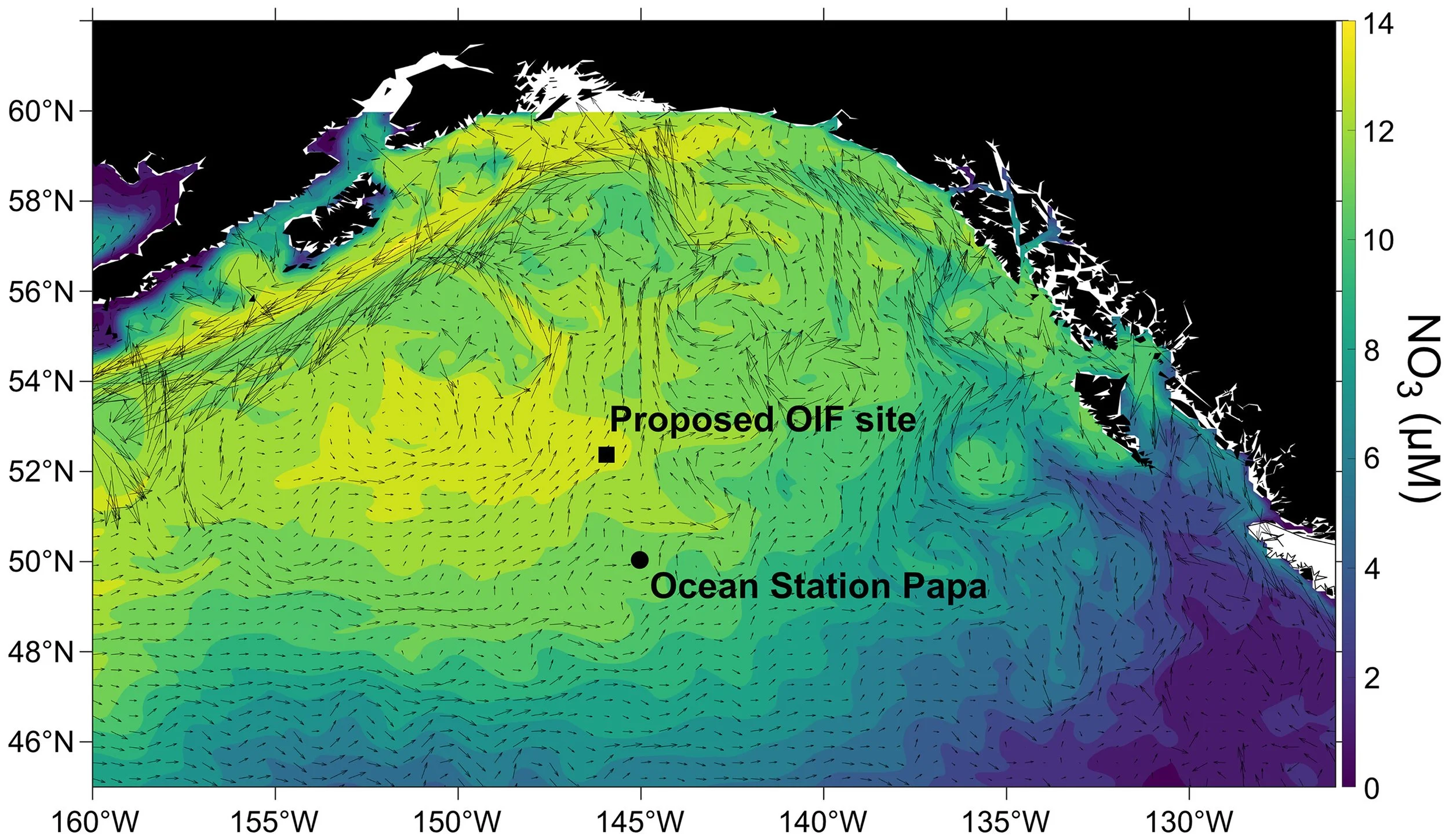
The proposed Northeast Pacific OIF field-study site, surface nitrate concentrations, currents, and Ocean Station Papa. Figure 3 from Buesseler et al. (2026), based on unpublished results by F. Chai and P. Xiu. Reused under CC BY-NC 4.0.