Estimates vary but credible evidence points to gigaton-scale climate change mitigation potential of biochar
Originally published in the journal, Communications Earth & Environment.
By Zhe Han Weng & Annette L. Cowie
Abstract
Biochar is a carbon dioxide (CO2) removal strategy that supports food security, sustainable land management and the circular economy. Nineteen published studies estimate global climate change mitigation potential of biochar at 0.03 to 11 Pg CO2 equivalent yr−1. Reconciling this range requires consideration of biochar science. Biochar systems durably sequester carbon, can reduce soil greenhouse gas (GHG) emissions, displace fossil fuel emissions through use of syngas, and avoid GHG emissions from residues. We reviewed the contributions to CO2 removal and GHG emissions reduction. Divergence between studies arises from differences in scope, definition of potential, and assumptions about biomass availability, biochar technologies and reference systems. Seven of the 19 studies reviewed relied one original study. Recent independent assessments estimate sustainable mitigation potential of biochar systems at 2.6-10.3 Pg CO2 equivalent yr−1. New assessments are needed, utilising integrated assessment models that incorporate latest understanding of biochar processes and feedstock availability.'
Introduction
Strategies to reduce greenhouse gas (GHG) emissions are critically important but will not be sufficient to achieve the temperature goal of the Paris Agreement. The IPCC1,2 has shown that it will also be necessary to remove carbon dioxide (CO2) from the atmosphere. Biochar is one of the few technologically mature strategies available to deliver CO2 removal (CDR). Biochar systems, that involve production of biochar for use as a soil amendment, combine a biological removal process with a durable storage mechanism3. Biochar systems can provide benefits for climate change adaptation, land degradation management, food security4 and human health (e.g. Mohammadi et al.5).
Biochars are charcoal-like heterogeneous porous materials produced by heating organic matter such as forestry residues or straw in an oxygen-limited environment, generally used as soil amendments6. Biochars vary widely in their properties, dependent on feedstock and production conditions. The production process is exothermic: a small amount of external heat is required to initiate pyrolysis, whereafter combustible gas is released, which is commonly used to fuel the process. Excess pyrolysis gas (also known as syngas) can be used as a renewable energy source for heat or electricity generation, replacing fossil fuels. Thus, renewable energy is a co-product of biochar production. Biochar production systems are sometimes also termed pyrogenic carbon capture and storage (PyCCS). In this review, biochar is assumed to be produced with other co-products of biomass pyrolysis, that is, bio-oil and syngas.
The primary contribution of biochar systems to climate change mitigation is CDR achieved through the persistence of biochar: biochar carbon persists in soil over centuries7,8,9 which greatly delays the oxidation of biochar compared with its biomass feedstock. Biochar can contribute additionally to climate change mitigation by building soil C through reduced mineralisation of soil organic matter10, reducing nitrous oxide (N2O) and methane (CH4) emissions from soil11, and through fossil fuel displacement12. Besides mitigation contributions, biochar could play an integral role in system-level strategies for sustainable development and the circular bioeconomy13,14,15.
While there has been intense activity to elucidate the mechanisms of biochar impacts on soil properties and plant response16, there are relatively few studies on the climate change mitigation value of biochar systems. Life cycle assessments (LCA) of biochar systems show wide variation between feedstocks, pyrolysis conditions, and biochar applications, though most biochar systems show substantial net climate benefits. In their Special report on Climate Change and the Land17, the IPCC reported mitigation potential for biochar in the range 0.4–1.2 t CO2 equivalent t−1 dry feedstock.
There are few studies on global mitigation potential of biochar. One of the most comprehensive studies of biochar mitigation potential, by Woolf et al.12, estimated global sustainable mitigation potential to be ~3.7–6.6 Pg CO2 equivalent yr−1. Synthesising available literature, the IPCC Sixth Assessment Report18 estimated theoretical potential of 0.2–6.6 Pg CO2 equivalent yr−1. There have been no critical reviews focussed solely on mitigation potential of biochar systems.
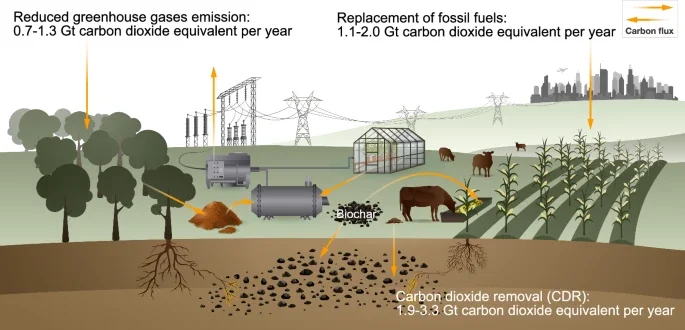
This paper reviews the literature on potential mitigation through biochar, examining the scope and assumptions applied, to pinpoint the basis for the wide variation between studies. We start by reviewing the various processes that provide GHG mitigation in biochar systems. We distinguish the contributions of different GHG mitigation processes to the net mitigation potential, separating CDR and GHG emissions reductions (Fig. 1 and Supplementary Table 1). We examine the relationship between studies of mitigation potential and distinguish novel analyses from those based on earlier studies. Here we show that most studies since 2010 are not new analyses, but instead many are based on the study by Woolf et al.12, sometimes misquoted or selectively extracted. Differences between studies sometimes arise from confusion between CO2 vs. C due to the unusual choice of units in the study by Woolf et al.12, but, more importantly, are largely due to differences in scope of the study (CDR and emissions reduction processes included) and assumed biomass availability.