Future Scenarios of Global Fisheries and Ocean Alkalinity Enhancement Under Socio-Economic and Climate Pathways
Earth’s Future
July 7, 2025

By Hans Sloterdijk, Caroline Grünhagen, Rudi Voss, Patricia Grasse, David P. Keller, Linda Kleemann, Lotta Clara Kluger, Kira Lancker, Wilfried Rickels, Ulf Riebesell, Renato Salvatteci, Andreas Oschlies, Jörn O. Schmidt, Natascha Oppelt, Katrin Rehdanz and Marie-Catherine Riekhof
Abstract
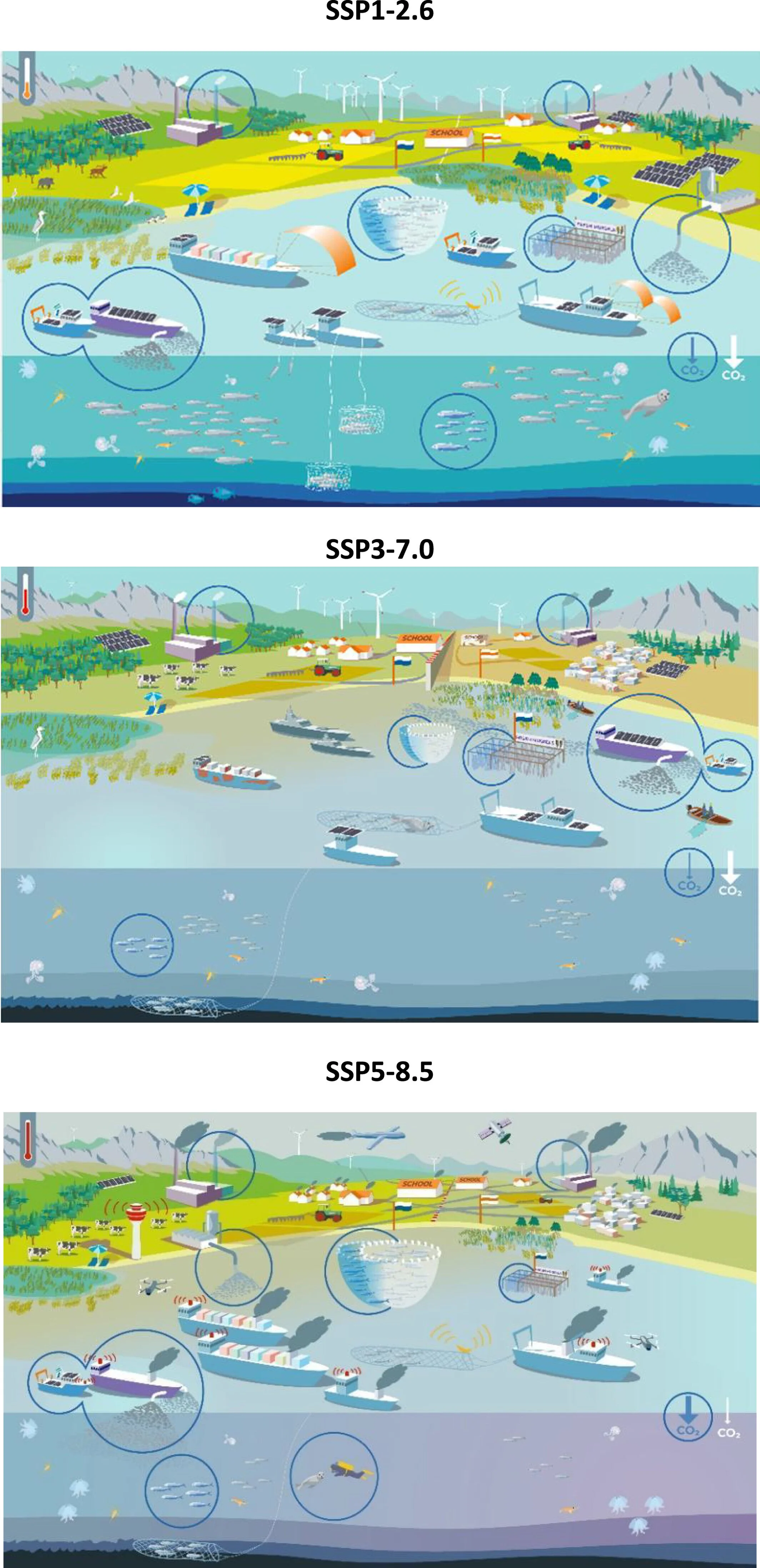
Comparative illustrations of the scenarios: SSP1-2.6, SSP3-7.0, and SSP5-8.5. These graphics visually represent the narratives of each scenario across different futures, emphasizing key differences in socio-economic development, policy implementation, climate change, fisheries, and the impact of OAE. Each illustration depicts two neighboring countries and the adjacent ocean, providing a spatial frame for comparison. The circles within each illustration highlight the differences in outcomes when OAE is implemented. Note: The graphics are designed to encourage active engagement by the reader, with limited textual detail to allow for independent exploration of the scenarios and reflection on how these dynamics unfold under varying socio-economic and climate pathways. Consider the following guiding questions: Do you notice changes in color related to water, atmosphere, or land? How might these relate to temperature or pollution? How do the types and numbers of human activities (e.g., energy use, infrastructure) differ across scenarios and between neighboring countries? Are there observable changes in ecosystem use?.
Achieving global climate goals while ensuring food security in a changing climate presents significant challenges, particularly when relying solely on land-based solutions. Covering over 70% of the Earth's surface, the ocean remains an underutilized resource for climate mitigation. Ocean alkalinity enhancement (OAE) is one such strategy, designed to strengthen the ocean's natural carbon sink, reduce atmospheric CO2, and mitigate ocean acidification. However, its implications for fisheries, critical for food security and livelihoods, remain uncertain. This study examines the interplay between global fisheries, OAE, and different future socioeconomic and climatic conditions, using the Shared Socioeconomic Pathways (SSPs) and Representative Concentration Pathways framework. We explore how global fisheries and OAE could evolve under three combined scenarios: SSP1-2.6 (sustainability-focused), SSP3-7.0 (regional rivalry), and SSP5-8.5 (high fossil fuel dependency). By integrating ecological, economic, societal, and technological perspectives, we develop scenario narratives and quantify key bio-economic parameters, including technological progress, fishing costs, fisheries management, marine aquaculture, and ecosystem carrying capacity. High-emission (SSP5-8.5) and fragmented development (SSP3-7.0) scenarios present significant barriers to the coexistence of OAE and fisheries, whereas sustainability-focused pathways (SSP1-2.6) offer the most favorable conditions for their alignment. Successfully integrating OAE with fisheries management will likely depend on technological advancements, international cooperation, and socio-economic developments. These scenarios are aligned with those used in model-based scenario studies conducted under the frameworks of the Intergovernmental Panel on Climate Change and the Intergovernmental Platform on Biodiversity and Ecosystem Services (IPBES), providing a shared foundation for future work.
Plain Language Summary
The world faces two major challenges: reducing climate change and ensuring food security. While many climate solutions focus on land, the ocean, covering over 70% of the Earth's surface, offers untapped potential. One proposed strategy is ocean alkalinity enhancement (OAE), which could help the ocean absorb more carbon dioxide from the atmosphere and reduce ocean acidification. However, little is known about how OAE might affect global fisheries, which are essential for food and livelihoods. Our study explores how fisheries and OAE could co-evolve under different future scenarios, considering climate change and socio-economic developments. We examine three possible futures: one focused on sustainability (SSP1-2.6), another marked by regional conflict (SSP3-7.0), and one with continued high fossil fuel use (SSP5-8.5). Using these scenarios, we analyze factors such as fishing costs, technology, aquaculture, and ecosystem health. We find that sustainability-focused pathways (SSP1-2.6) create the best conditions for OAE and fisheries, while high-emission and fragmented development scenarios present major challenges. The successful implementation of OAE alongside fisheries management will likely depend on technological progress, international cooperation, and economic policies. We expect that these scenarios will be a common starting point for future model-based scenario studies related to the work of the Intergovernmental Panel on Climate Change and Intergovernmental Platform on Biodiversity and Ecosystem Services.