Substantial Limitations of Ocean Alkalinity Enhancement in Mitigating the Negative Impacts of Ocean Acidification on Marine Calcifiers
Environmental Science & Technology | December 28, 2025
By Hanna van de Mortel, Nina Bednaršek, Greg Pelletier, Richard A. Feely, Jens D. Müller & Nicolas Gruber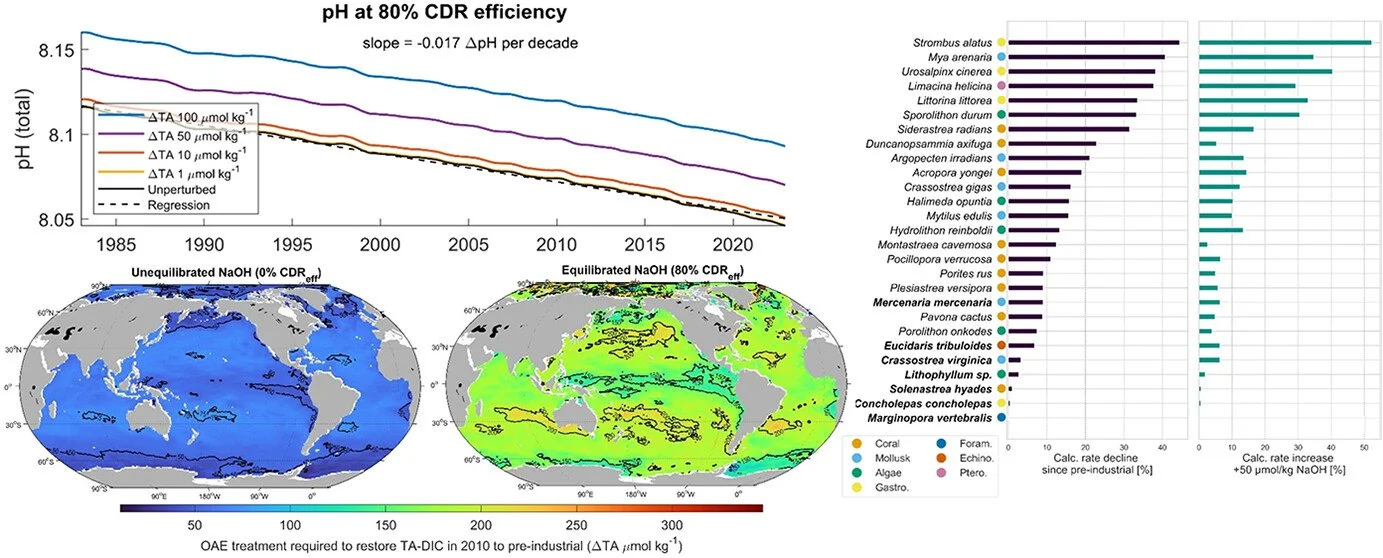
Abstract
Ocean Alkalinity Enhancement (OAE) is increasingly considered as a marine carbon dioxide removal (mCDR) strategy with the potential cobenefit of mitigating ocean acidification (OA), but this remains poorly constrained. Here, we evaluate these biological cobenefits for 27 marine calcifiers whose calcification has declined under OA, by quantifying both historical OA-driven calcification losses and the potential of OAE to reverse them under scenarios with and without air–sea equilibration. Regression models describing calcification as a function of TA-DIC reveal substantial declines since preindustrial times, particularly in linear responders (mean 22%, range 7–44%), such as gastropods and pteropods, while threshold responders show minimal decline (∼3%). A realistic addition of 50 μmol kg–1 of OAE alkalinity restores species-specific calcification rates maximally only between 0 and 52.2%, with the largest benefits in OA-sensitive taxa. However, restoring preindustrial calcification requires far larger TA additions (mean 104 ± 58 μmol kg–1 without equilibration and more than triple this amount when equilibration with atmospheric CO2 is considered). While higher CDR efficiency enhances atmospheric CO2 drawdown, it simultaneously reduces the potential for biological OA mitigation. Thus, restoration of marine calcifiers through the OAE will not necessarily align with its climate goals, complicating its application in ocean management and CDR policy.