Will there be a super El Niño later this year? Here’s what that would mean.
New data suggests this has the potential to become one of the strongest El Niño events on record.
The Washington Post | March 9, 2026
By Ben Noll
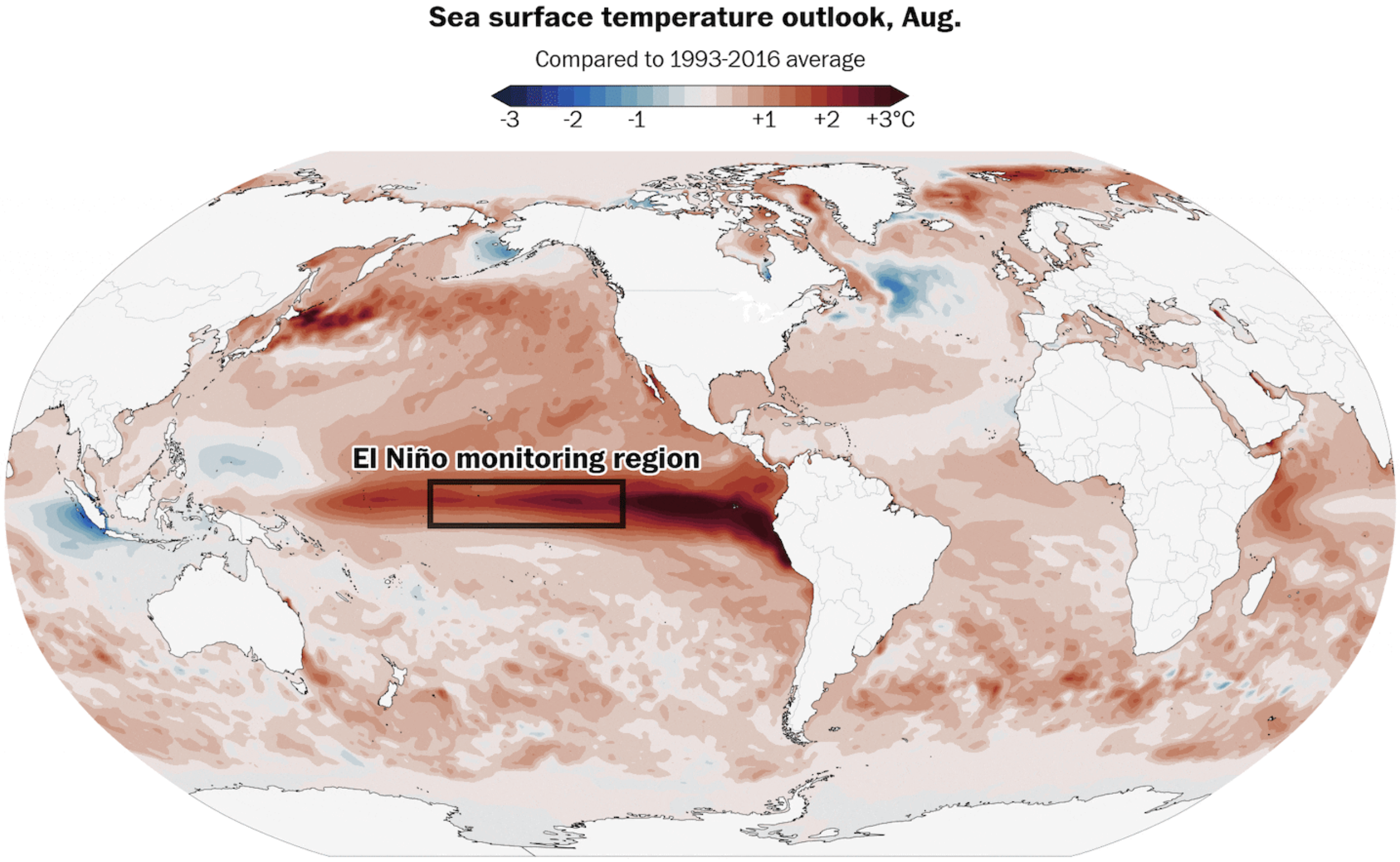
The planet may experience a strong or even a super El Niño later this year, one that could rival the strongest ones in history, according to new climate data recently released by the European Center for Medium-Range Weather Forecasts (ECMWF).
A typical El Niño affects regional-to-global weather patterns, as a warming patch of water in the equatorial Pacific Ocean influences what regions could experience droughts, floods and extreme heat. During these relatively rare super El Niño events, happening once every 10 to 15 years on average, the effects may be stronger, more persistent and more widespread.
That’s because sea temperatures in that key region of the Pacific Ocean warm more than 2 degrees Celsius above average, leading to a profound atmospheric response.
Those impacts can include the frequency and location of heat waves, the locations of flooding downpours and drought could focus, where hurricanes may hit, and declining sea ice concentrations. For example, the Western United States could face a hotter than average summer, some tropical countries could face worse drought and extreme heat, while more tropical cyclones could develop in the Pacific, with fewer in the Atlantic.
There’s also a growing chance that this year’s El Niño, especially if it’s a strong one, would push global temperatures to record levels, particularly in 2027.
It’s a possibility that has the attention of climate scientists, though there are a range of views on how strong it may become.
“Whew," wrote climate scientist Daniel Swain last weekin a post on X. “All signs are increasingly pointing to a significant, if not strong to very strong, El Niño event.”